
Modern projects fail because governance fails.
A position paper from SPGX Group on why independent programme governance has become the deciding factor on complex international developments and recovery programmes.
- 01Introduction
- 02The industry challenge
- 03The SPGX philosophy
- 04The operating system
- 05Independence
- 06Programme leadership
- 07Why governments work differently
- 08The future
A quiet observation about why programmes fail.
Across two decades of complex international developments — ultra-luxury hospitality, mixed-use towers, infrastructure, and post-disaster recovery — one pattern repeats. Programmes do not fail because designers lack talent, contractors lack capacity, or engineers lack rigour. They fail because the connective tissue above them — the governance — is weak, fragmented, or absent.
The modern programme has outgrown traditional delivery. Stakeholders multiply. Information disperses. Decisions slip. By the time a board sees a problem, the problem is already months old.
SPGX exists to address that gap — not by replacing the people who do the work, but by giving owners the governance, intelligence and independence required to run their programmes with confidence.
“Projects fail because governance fails — not because people don't work hard enough.”
The structural conditions of modern delivery.
Complex programmes today share the same structural conditions: a long chain of specialist consultants, contractors and authorities, each optimising their own scope; an owner organisation that depends on filtered reporting; and a governance layer that often exists in name rather than in practice.
The consequences are familiar:
- Fragmented deliveryDisciplines coordinated by email, not by structure.
- Conflicting interestsParties paid to deliver scope, not to protect outcomes.
- Poor governanceDecisions made in the gap between committees.
- Lack of transparencyReporting that describes activity, not status.
- Reactive decision-makingIssues escalated only after they become risks.
- Disconnected reportingMultiple sources of truth, none of them definitive.
- Stakeholder misalignmentDesigners, contractors and owners optimising different things.
None of these are problems of individual competence. They are problems of system design. They are the predictable output of a delivery model that was built for simpler programmes than the ones we now ask it to carry.
Align the practitioners; govern the programme; protect the owner.
SPGX does not replace designers, contractors or engineers. The specialist disciplines that design and build the work remain essential; the value they create is not the problem.
SPGX sits above that delivery layer, on the owner's side of the table. The remit is straightforward: align the practitioners around a shared programme intent; govern the programme through a defined operating system; and protect the owner's interests through independent intelligence, controls and reporting.
“SPGX never replaces the practitioners. We align them, govern the programme, protect the owner, and create the conditions for confident decisions.”
The result is not more activity. It is fewer surprises, earlier decisions, and a board that knows where the programme actually stands.
One connected system, not eight separate services.
The SPGX operating system is a single, connected practice. Each component is meaningful on its own; together they are the reason governance holds under pressure.
- RISE™The structuring framework — Respond, Inspect, Stabilise, Execute.Read →
- Recovery Programme OfficeThe embedded owner-side command structure.Read →
- Recovery IntelligenceThe information layer that turns activity into decisions.Read →
- Operational Intelligence CentreA single source of programme truth.Read →
- Programme ControlsScope, schedule, cost, risk and quality held as one baseline.Read →
- Decision GatesDefined moments at which the programme is permitted to advance.Read →
- Governance FrameworkThe decision architecture above the programme.Read →
- Executive ReportingBoard-grade reporting, designed for decisions.Read →
- Global Partner NetworkPre-qualified specialist firms mobilised under one operating system.Read →
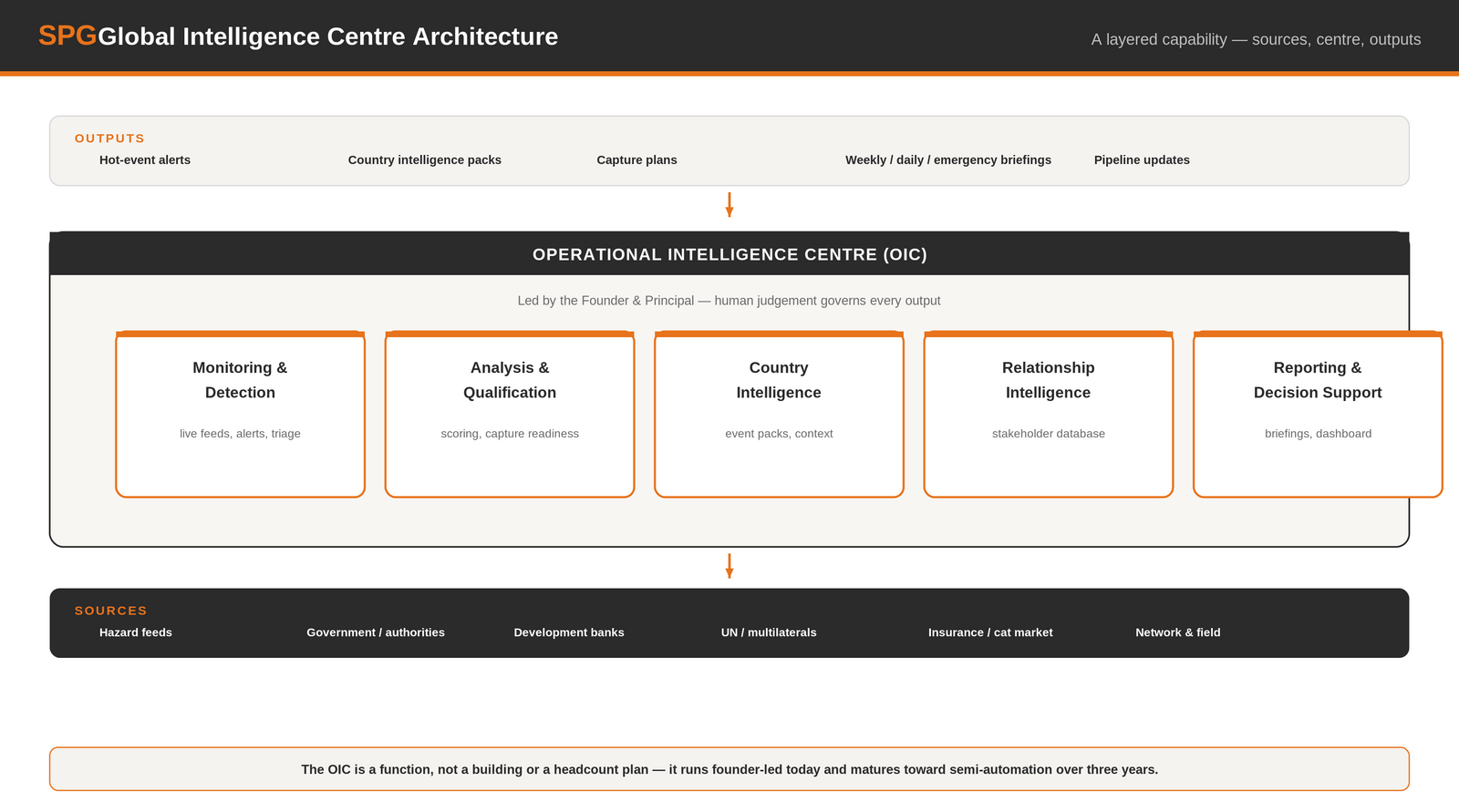
The full knowledge centre, including the individual methodologies, is documented at /methodologies.
The owner's interests, undivided.
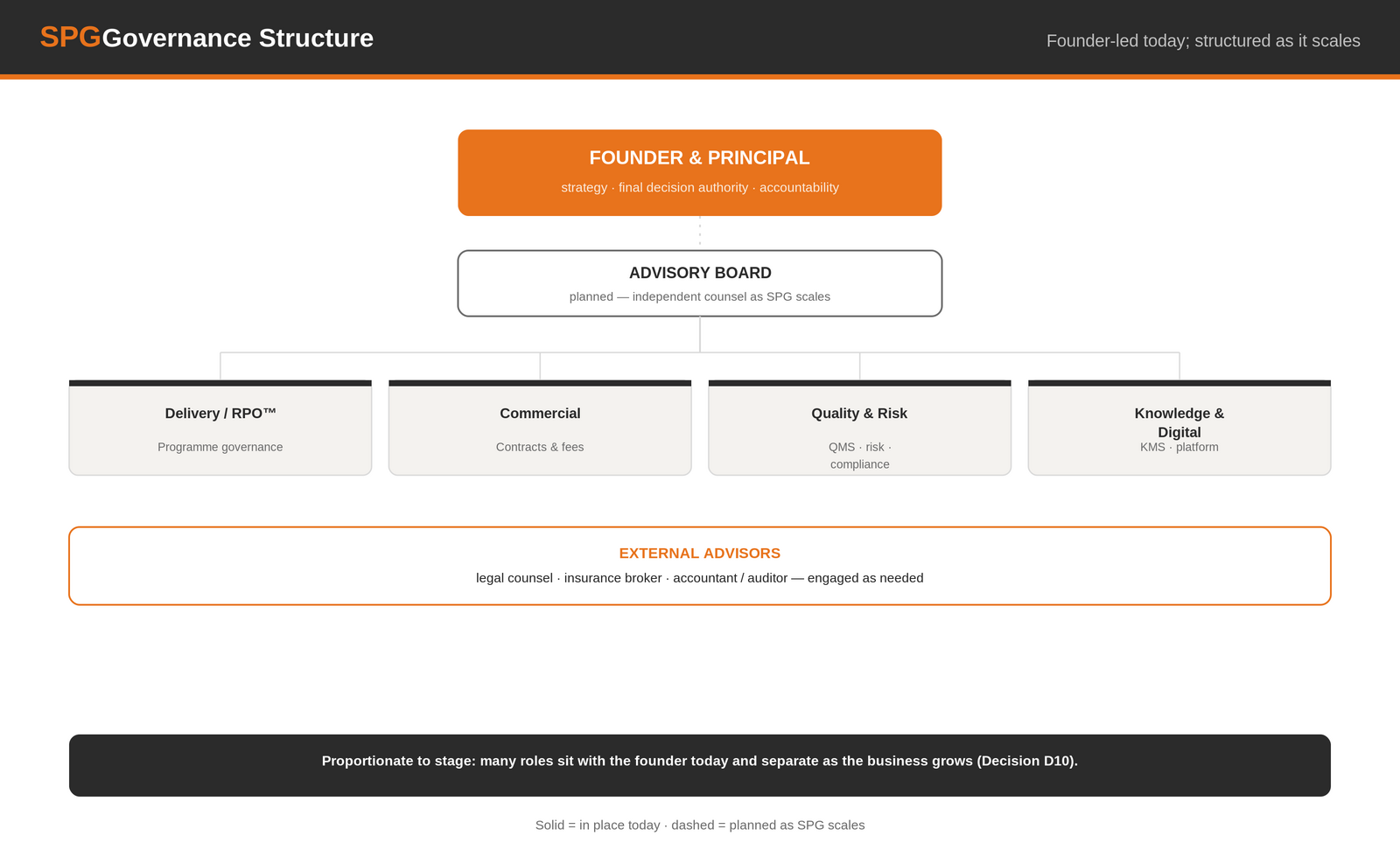
Independence is the quietest and most important characteristic of the firm. SPGX represents the owner's interests — not the contractor's, not the engineer's, not the insurer's, not the financier's.
That sounds obvious until one looks closely at how complex programmes are typically staffed. The same firms that design the work often verify it. The same firms that build it often advise on it. The same firms that insure it often shape the scope of repair. Each of these arrangements is workable in isolation; collectively they leave the owner without a single party whose only obligation is to them.
“Independence is not a posture. It is the structural condition under which honest reporting is possible.”
A capability built through complex programmes, not invented for them.
The disciplines codified inside SPGX did not begin as theory. They were developed across more than a decade of programme leadership on complex international developments — ultra-luxury residential and hospitality, mixed-use developments, multi-jurisdictional assignments, post-disaster recovery, and executive advisory at board level.
The recurring lesson across that experience is the one set out at the beginning of this paper: governance is the deciding factor. That conclusion led naturally to a flagship division — Disaster Recovery & Resilience — where the cost of weak governance is most immediate and most visible.
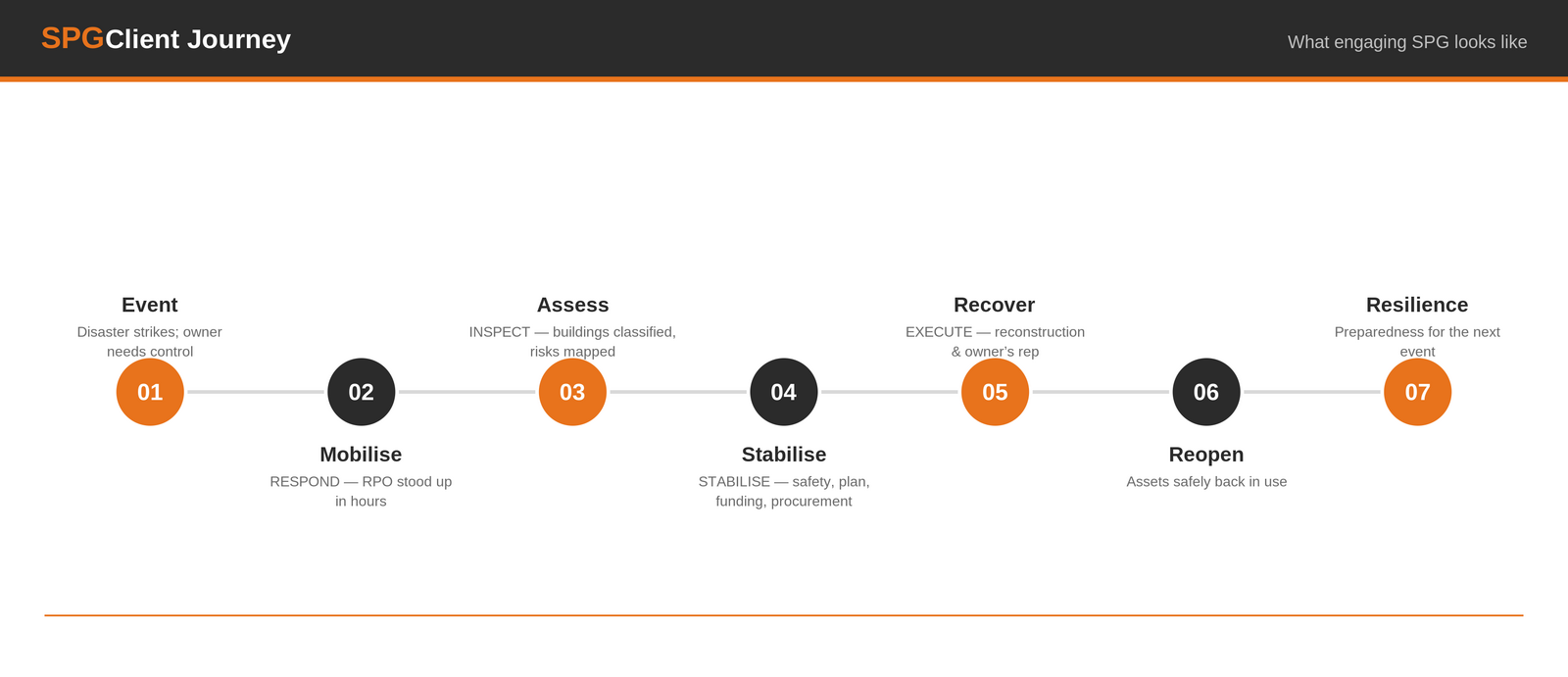
The full corporate history, including the projects that shaped this capability, is documented at /experience.
Public and institutional programmes raise the governance bar.
Commercial owners care about outcome. Governments, development banks and institutional owners care about outcome and process — and they are right to. Public capital, public oversight and public consequence impose a different standard of evidence, traceability and decision discipline.
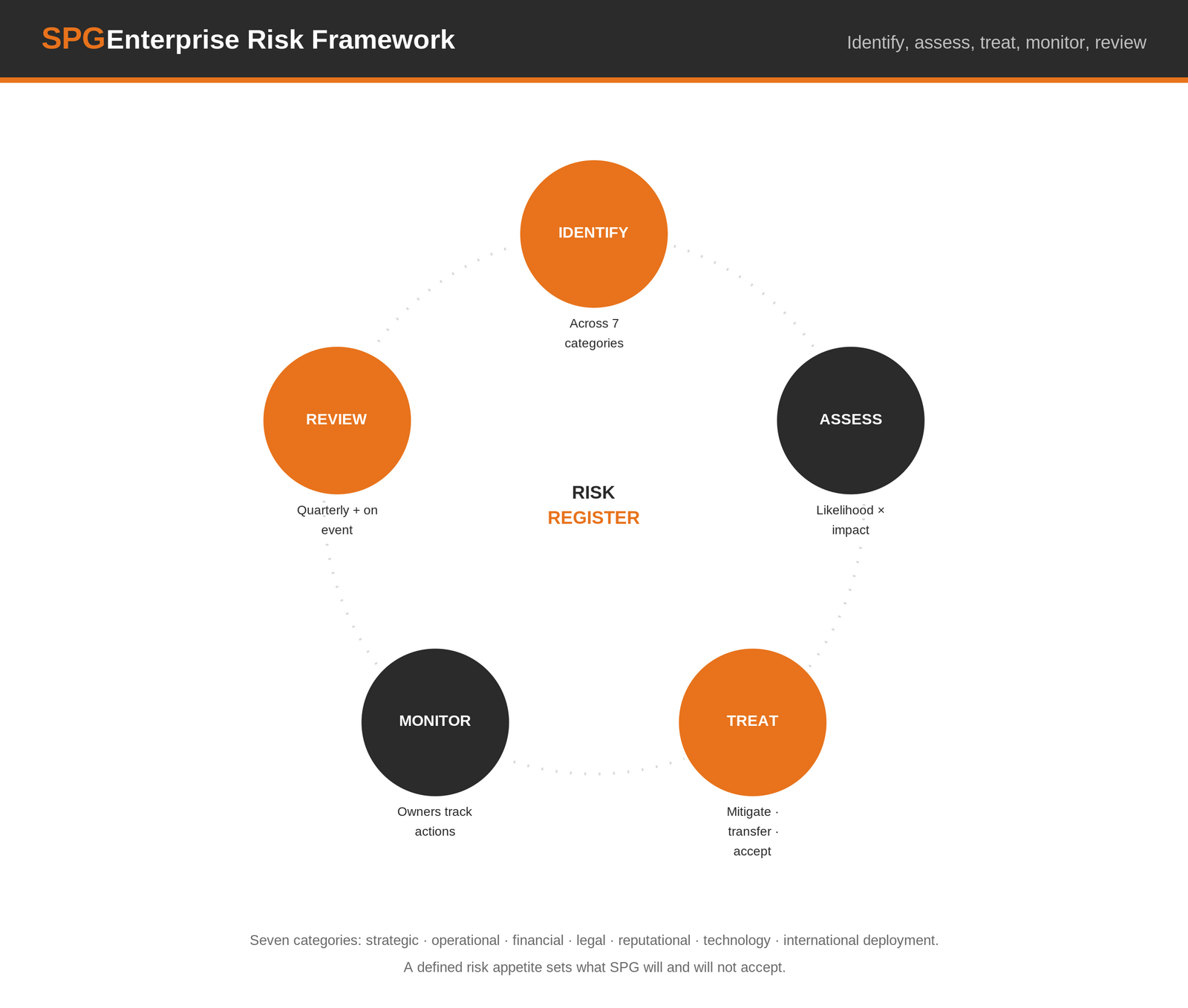
Governance matters on every programme. On public and institutional programmes, it is the work.
The sectors in which this applies are set out at /industries.
Digital intelligence, human judgement, independent advice.
The next decade of programme management will be defined by the combination of digital intelligence and human judgement — not the replacement of one by the other. AI-assisted reporting, integrated controls, real-time programme data and pre-qualified global networks will compress the distance between event and decision.
That capability is only useful inside a governance framework that can absorb it. Without governance, faster information produces faster confusion. With governance, it produces earlier, better decisions.
SPGX is being built for that environment: independent advisory, digital intelligence, a global partner ecosystem, and a disciplined operating system that connects them.
“Better programme governance is the precondition for everything else — resilience, recovery, value, and trust.”
The position paper, applied across the practice.
- Services
How the operating system is delivered to clients.
- Industries
The sectors in which the governance bar is highest.
- Methodologies
The full knowledge centre of frameworks and controls.
- Projects & Experience
The programmes that shaped the capability.
- Insights
Position papers, briefings and reference notes.
- Contact
Speak with SPGX about a programme.
Discuss the position paper with the partners.
If the questions raised here apply to a programme you are accountable for, the conversation is direct, confidential and without obligation.